

The Restoration
- The DIY Scholar

- Sep 2, 2025
- 5 min read
Tonight, after my shift, I dyed my hair in the basement of The Community Center. I did it for old times’ sake.
Sometimes there are zones of overlap, points of intersection, between the present and the past, where the present, some aspect of it, some unassuming detail, becomes the portal through which the past makes an unsolicited appearance.
The basement sink, a floor sink, tucked away in the supply closet at the very end of the hallway, the most intimate corner of the building, is one such portal. I recognized it immediately, though ‘recognize’ is perhaps not the right verb, since I was not the agent but the recipient of the action, which is to say that it was the floor sink that took a hold of me, that acted upon me, not the other way around.
The basement floor sink is the gravitational center of my shift, the ground zero of my janitorial habitus. When not in use, the Zamboni Industrial Electric Walk-Behind Auto Floor Scrubber resides there, nestled in the coziest corner of the supply closet, right next to the powerful and captivating floor sink. The first act of my shift, the foundational one, is to awaken the Zamboni from its slumber, unplug it from the charging dock, fill its tank with cleaning solution, and fit it with the red scrubbing pad, twenty inches in diameter, that otherwise hangs from the hook on the wall. The last act before clocking out at the end of my shift and being whisked away down the floor drain of the rest of my life is to drain the dirty water, empty the filter, lovingly clean the inner tank, hang the red scouring pad on the hook on the wall, plug the Zamboni back into the charging station, and in this manner tuck it in for the night. I close the door to the supply closet gently, turning the handle slowly, holding my breath, waiting for the soft click in the lock, so as not to startle the Zamboni from its hard-won rest.
I return to the supply closet obsessively throughout my shift. Never able to free myself fully from its hold, I can often be found genuflecting at the foot of the basin of the floor sink. It is where I empty the dirty mop water, refill the spray bottles, top off the Zamboni’s tank with scrubbing solution, splash water on my face, or simply zone out, hypnotized by the maverick movements of the suds on the current as they collide and scuddle in ever tightening circles toward the center of the drain.
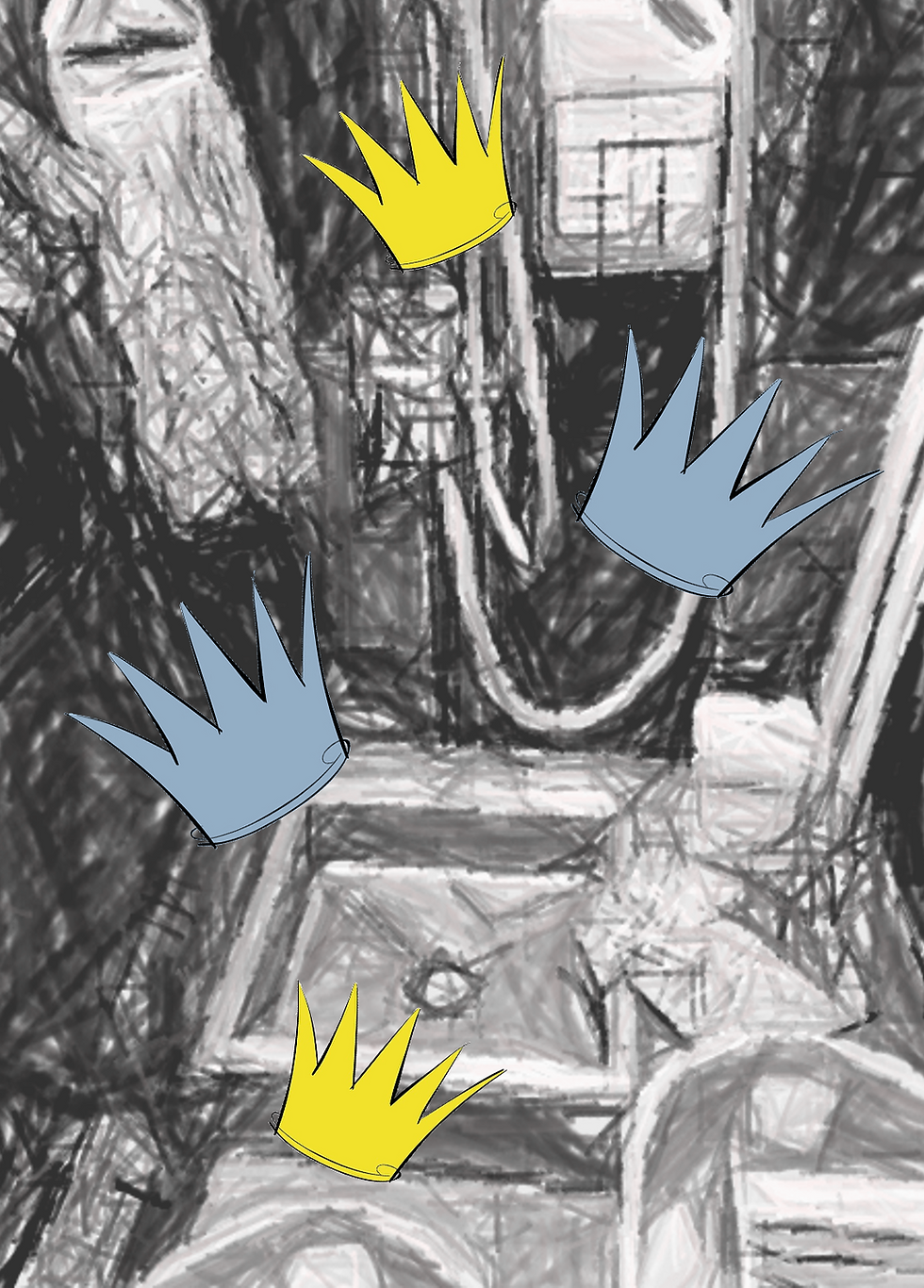
Perhaps it is the size of the tub. Perhaps it is the volume of water or the wild gyrations of the clusters of suds that I find so enthralling, so unsettling, so reckless but nonetheless necessary. When I focus deeply on the drain, when I squint my eyes and peer into the impenetrable darkness of the center of the drain, the crystal ball, when it grabs a hold of me and I abandon myself to its pull, how can I not think of the basement of the three-flat back in Branson, how can I not see the image coming into focus?
Hazy at first but clearer as it progresses, the image comes alive. Can’t see you it there? The doorknob turning? The door opening without a sound? Follow the Young Punk, still green, still wet behind the ears, as he emerges from the door and takes his first tentative steps into the hallway. Watch as he ducks into the back stairwell, taking the stairs one at a time, sticking close to the wall so that the floorboards don’t creak. Upon reaching the basement, he scuddles silently across the cold concrete floor, past the water heaters, past the furnaces, past the sump pump, all the way to the far corner, the farthest, the darkest, the quietest, all the way to deep, double-basined sink next to the washing machine. The front wall of the basin is slanted at an angle of sixty degrees with a washboard built into its surface. It is here that The Young Punk lays out his supplies: the hair dye that he lifted from the drug store on his way home from school, the shower cap, the plastic gloves, and the small tape deck with the Los Crudos demo, soon to be released as a seven inch.
Watch as the ritual begins. He presses play and checks to make sure that the volume is just high enough to hear but low enough not to wake anyone up: he is the only one up in the building and wants to keep it that way. The smell of ammonia overtakes his workspace as he opens the bottles and mixes the chemicals until the color and consistency are even. With gloved hands, he applies the solution with confidence and vigor, working up a lather as his fingers make their way from tip to root to scalp.
Notice the little smudge of hair dye on the crest of his ear. There is no question that it will leave a stain that will take a few days of scrubbing to go away. There is a similar situation where his hairline meets the skin of the back of his neck, as if his hair were casting a shadow, independent of the single light bulb that hangs from the ceiling. Not seeming to notice or care, he proceeds, unabashedly, without stopping or looking back, to the next phase of the ritual.
He fits the shower cap over his head and turns the tape over to the B side. Then he takes his air guitar out of its case, plugs it into its amp, turns up the volume of the Marshall Half Stack, tunes up rather hastily, and starts rocking out. It must be hard to dance with so much abandon while playing air guitar at the same time, hitting every note. Somehow, he pulls it off. A lot of people turned out for the show, and The Young Punk feeds off the energy of the imagined crowd, his fellow conspirators, turning it into maelstrom of chords and notes. The song comes to an end. The Air Guitarist collapses to the ground, spent. The crowd goes wild.
The tape reaches the end of the B side. It is time to rinse. The Air Guitarist takes off his shirt, removes the shower cap, strips down to his waist, folds his torso into the welcoming basin, turns on the faucet, and watches as the burgundy solution swirls around the bottom of the sink, racing toward the drain. The water runs progressively clearer until there are no more traces of hair dye. The Shirtless Young Punk turns off the faucet. The last cluster of suds crowds the drain. When he emerges from the basin, he will be transformed. He will be one step closer.
The floor drain in the supply closet of the basement of The Community Center made a prolonged slurping sound as the last suds disappeared down The Impenetrable Darkness.
I had done it again. After so many years, I emerged transformed, more burgundy than ever. Some might call it a regression, but this would imply that I had set out in search of the past. This interpretation confuses the subject with the object of the action because, as it turns out, it was the past that came looking for me and, indeed, found me, there in the basement, kneeled before the floor sink, repeating a ritual, which is what, after all, rituals are for, less of a regression than a restoration.


Comments